Shri Balumama · 1892 – 1966
Shri Balumama: the shepherd saint of Admapur
Born in a shepherd's family in 1892, Shri Balumama spent his life walking the villages of Maharashtra and Karnataka with his flock. Lakhs of devotees come to his samadhi at Admapur every year. This page gathers what is known of his life, for those who want to understand the place before they visit it.
Compiled from published accounts. Corrections are welcome.
- Born
- 3 October 1892
- Akkol, Belgaum district
- Community
- Dhangar
- Shepherds of the Deccan
- Samadhi
- 4 September 1966
- Admapur, Kolhapur
- The flock
- From fifteen sheep
- Still walking
Beginnings
Early life
Balumama was born on 3 October 1892 at Akkol, a small village in Chikodi taluka of Belgaum district, in what is now Karnataka. His family belonged to the Dhangar community of shepherds, and his father's name is recorded as Mayappa.
Accounts of his childhood describe a boy who was often absent from the work around him, absorbed in something the people nearby could not see. He grew up speaking both Kannada and Marathi, which is one reason his following spread on both sides of a border that meant little to the villages he walked between.
On the road
His spiritual journey
He was married young, in the ordinary way of the time and by his family's arrangement rather than his own wish. The household did not last. What followed instead was a life on the move: he was given about fifteen sheep, and he took them out.
The Marathi accounts place him in a line of teachers reaching back through Shri Mouni Maharaj of Patgaon to Shri Mulye Maharaj, who is named as his guru. For decades afterwards he walked with his flock through the villages of Kolhapur, Belgaum and beyond, staying where he was welcomed and moving on.
It was in those villages that his reputation formed. Devotees recount healings, food appearing where there was none, and warnings that proved right. The accounts are told as devotees tell them, and they are the reason the flock kept growing, because families gave sheep to it as offerings.
If you consider me dead, then I am dead. If you consider me alive, then I am alive.
Shri Balumama
The practice
What he taught
His teaching was plain and he repeated it rather than elaborating it: constant remembrance of the name, in the words "Ramkrishnahari". Not a doctrine so much as a practice available to people who could not read.
He was vegetarian all his life. He argued against superstition, which is worth noting about a man to whom miracles were attributed. He drew no line between castes, and the crowd at Admapur today is drawn from all of them.
What is not known
Family and household
Balumama married young, and the marriage was arranged against his own wishes. He did not remain in household life, and the sources that describe this are brief about it.
You will find a name for his wife on some websites. It is the same name that Marathi accounts give for his mother, which means at least one of the two is wrong, and we would rather leave a gap here than repeat an error about a family that people revere. The Shri Balumama Sansthana at Admapur is the authority on this, not us.
Still walking
The flock
The sheep are not incidental to his story, they are the centre of it. He began with about fifteen. Devotees say the flock now numbers in the tens of thousands, kept and moved by his followers in the way he kept it himself.
The flock still walks. Where it passes, families come out to it, and a field it rests in is held to be blessed for the season. If you are staying in the area and the flock is nearby, ask: people will know where it is.
The pillar
The rankhamb at Metke
At Metke, a village near Admapur on the bank of the Chikotra, stands a pillar Balumama raised himself in 1932. A devotee brought a teak tree to the village and it was shaped into a pillar under his eye. Of it he is remembered as saying that one pillar stands in Kailas and the other at Metke.
For eleven months of the year the wood is closed inside a sheath of five metals. Through the month of Shravan the sheath is lifted, and after puja and abhishek by the trust the original teak is open for darshan. Devotees walk round it, and they hold that what is lifted there is not only what people call possession but the fear and despair a person arrives carrying.
For anyone planning a visit, the two things worth knowing together: the pillar is open in Shravan, and the punyatithi falls in Shravan as well. The month carries both, which is also why rooms in Admapur go early.
Admapur
Samadhi and the temple at Admapur
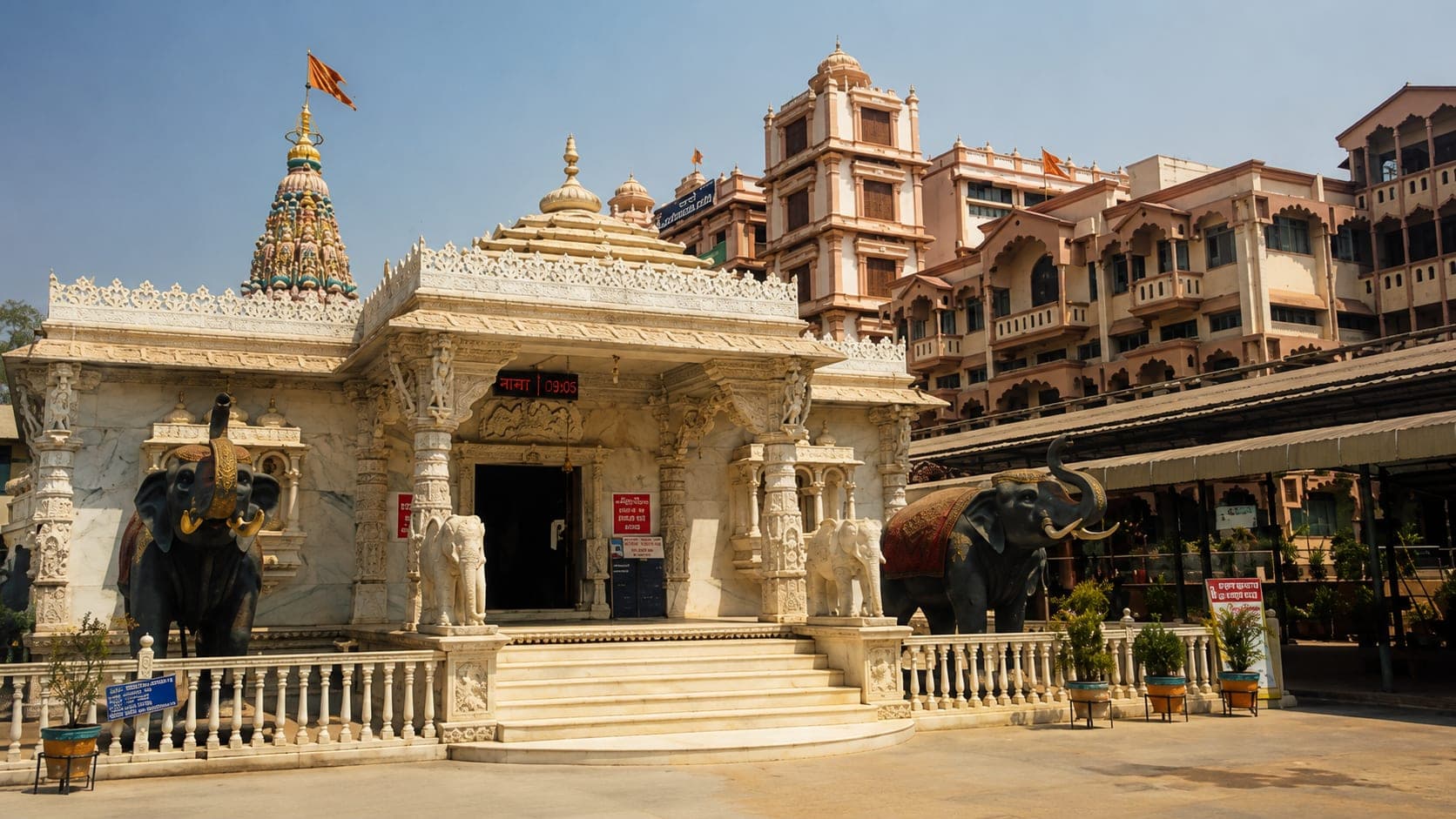
Balumama attained samadhi on 4 September 1966 at Admapur, in Bhudargad taluka of Kolhapur district. The temple was raised over the samadhi, and it is what the village is known for now.
The complex is in white marble, and around it are the other places devotees visit: the Margubai temple where he spent much of his time, the wada where he lived, with his belongings kept as they were, and the hall where prasad is served. It is administered by the Shri Balumama Sansthana.
Fairs and festivals
The devotional calendar matters more than the Gregorian one here. Both of the days below fall on a tithi, so they move each year.
Punyatithi
Shravan Vadya Chaturthi
The observance of his samadhi, and the largest gathering of the year. The programme at Admapur runs for several days before the day itself, ending in early September.
Jayanti
Ashwin Shuddha Dwadashi
His birth anniversary, kept at the temple with the customary programme.
Bhandara Utsav
Held since 1932
The bhandara he began in his own lifetime, and it has continued at Admapur since. Turmeric is thrown by the quintal.
Planning your darshan
- Around 5
- Morning puja
- Around 9
- Naivedya
- 7 to 7:30
- Evening aarti
- Sundays, amavasya
- Prasad of nachani ambil
Confirm these with the Sansthana before you plan around them, particularly on festival days, when everything shifts.
Timings are as published and can change. Please confirm locally.
Frequently asked questions
- Who was Balumama?
- Shri Balumama (1892 to 1966) was a saint of the Dhangar shepherd community, born at Akkol in Belgaum district and revered across Maharashtra and Karnataka. He spent his life travelling with his flock of sheep, teaching constant remembrance of the name, and is remembered by devotees for miracles of healing and provision. His samadhi is at Admapur in Kolhapur district.
- Where is the Balumama temple?
- At Admapur, in Bhudargad taluka of Kolhapur district, Maharashtra, on the road between Nipani in Karnataka and Radhanagari. The samadhi temple is administered by the Shri Balumama Sansthana.
- When did Balumama attain samadhi?
- On 4 September 1966, at Admapur. The anniversary is observed on Shravan Vadya Chaturthi, which is the largest gathering at the temple each year.
- What is the story of Balumama's sheep?
- He was given about fifteen sheep as a young man and spent his life moving with the flock. Devotees added to it as offerings, and it is said to number in the tens of thousands now, still tended by his followers. It is held that a field the flock rests in is blessed.
- What is the rankhamb at Metke?
- A teak pillar that Balumama raised at Metke, near Admapur, in 1932. It is kept inside a sheath of five metals for most of the year and opened for darshan through the month of Shravan, after puja by the trust. Devotees walk round it and hold that it lifts affliction, fear and despair.
- What is the Bhandara Utsav at Admapur?
- The Bhandara Utsav is a major annual festival started by Balumama in 1932. Lakhs of devotees gather at Admapur, where turmeric (bhandara) is offered in celebration, filling the temple town with gold colour and devotion.
- What are the daily aarti, puja and darshan timings at Balumama Temple?
- Morning puja begins around 5:00 AM, naivedya is offered around 9:00 AM, and evening aarti takes place between 7:00 PM and 7:30 PM. On Sundays and Amavasya, nachani ambil prasad is served to devotees. Timings may shift during festivals.
- How do I reach Shri Balumama Temple in Admapur from Kolhapur?
- Admapur is located about 35 km from Kolhapur in Bhudargad taluka. You can take a direct state transport bus or cab from Kolhapur Central Bus Stand (CBS) via the Nipani-Radhanagari road, which takes approximately 35 to 45 minutes.
- Where can I stay near the Balumama temple?
- Hotel Triveni is a two-minute walk from the temple at Admapur, with AC and non-AC rooms, suites, a pure vegetarian option at the restaurant and parking for buses and cars. Early breakfast is served for devotees going for darshan.
Sources
Compiled from the Shri Balumama Sansthana's published material, Marathi devotional accounts and press reporting of the annual observances. Where sources disagreed, the detail was left out. If you know a date or a name here to be wrong, please tell us and we will correct it.
Staying at Admapur
Hotel Triveni is two minutes from the temple. Rooms, meals and parking for families and pilgrim groups.